National Endowment
To give every American a stake in our nation’s prosperity.
7 in 10
Feel the economy is rigged against them
1 in 6
Children in poverty
4 in 10
Young people proud to be American
5 in 10
Young Americans can expect to earn more than their parents
The Full Story
The National Endowment will be a substantial fund invested in American corporations, whose earnings are shared equally among all citizens. This institution will allow all American citizens to share in the spectacular benefits of our thriving free-market capitalist economy.
The Solution
How does this work in real life?
Every citizen born or naturalized in the United States receives 1,000 shares (an arbitrary number) in their individually named account, ensuring that every citizen has an equal claim on the earnings from the National Endowment.
01
The Endowment will invest primarily in American companies with share ownership capped at 20% of any individual company to prevent it from owning controlling interests. The fund will be managed by a professional staff allocating money to outside managers across a variety of asset classes -- with a mandate to optimize financial returns. (See Funding Options below)
02
Like other private endowments, the fund will take advantage of opportunities to invest in private equity, securitized debt, venture capital or other financial instruments usually available only to the very rich.
The independent Federal Reserve Board will oversee the management of the Endowment, and its expenses will be self-funded like all endowments and the Fed itself, providing several layers of insulation from the whims of politicians.
03
A portion of the proceeds from these investments will be distributed annually as a dividend, deposited directly into every citizen’s account to save, invest, or spend as they see fit. As the fund reaches scale -- ultimately to the about size of Blackrock (over $14 trillion AUM), the annual distributions will increase proportionately.
04

Dividends will provide supplemental income for every American citizen as their birthright in exchagne for active participation in our democracy.
(Just like the Alaska Permanent Fund has done for half a century.)
05
The base 1,000 shares cannot be sold or transferred and will revert to the National Endowment upon death, to be granted to the next newly eligible citizen.
06
Gives everyone a stake
The National Endowment ensures that every citizen owns a share of profits from the economic system they help sustain, making real the belief that "we're all in this together."
Politically Resilient
Real ownership protects citizens from the whims of politicians and the ravages of inflation. No one can take away your right to your fair share.
No one in Alaska dares to mess with the Alaskan Permanent Fund!
AI + Automation Buffer
AI-augmented automation will continue to drive the wedge between capital and labor while producing enormous gains. The National Endowment ensures that this growth is widely shared. .
Capitalism Endures
Restoring fairness and giving every citizen "skin in the game" helps us keep faith in our system of democratic capitalism. The National Endowment makes this wonderful citizen work for everyone, not just the wealthy.
Precedent
The Alaska Permanent Fund

Fifty years ago, the people of Alaska invented a novel and durable way to ensure that shared wealth benefits everyone. In 1976, voters amended the state constitution to establish the Alaska Permanent Fund, insulating a portion of oil and gas revenues from political spending and preserving them for the public.
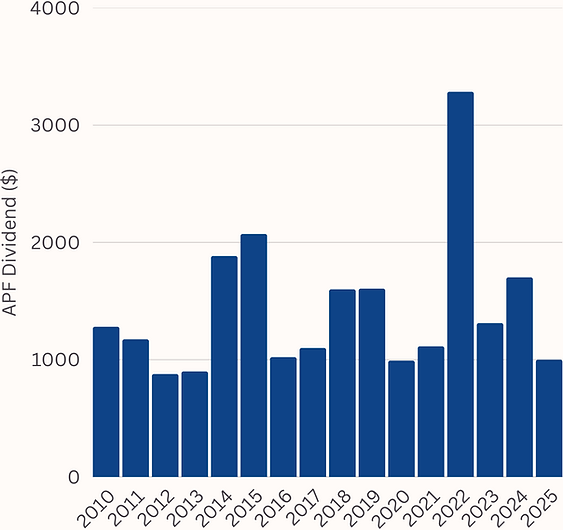
The Alaska Permanent Fund collects a royalty payment on oil and natural gas that is pumped out of state lands in Alaska. Most of that revenue is distributed as an annual dividend check to every resident of Alaska. The rest is invested for future generations.
The payout fluctuates with prices and production each year, but has averaged $1400 per resident per year since 2010. Alaskans have come to count on that income to supplement their earnings – as they should. After all, the oil and gas belong to them. The State simply holds those resources in trust for the public. And woe to any politician who so much as whispers about holding back on those checks.
Funding Options
1. AI Windfall Profits Tax
The AI revolution is being built upon the intellectual property of humankind: Every book, article, line of code, and scientific dataset that humanity has produced and digitized. Why should the profits built upon the common effort of people across generations be captured solely by those who exploit that knowledge? The public, which provided the language, the history, and the vast majority of knowledge on which AI is founded and from which it draws its power, is entitled to a royalty for its contribution. Setting a modest royalty on AI profits will help spread the wealth of the AI revolution to all those who made it possible.
2. Restoring Fairness to the Estate Tax
A tax on inheritance in excess of $50 million will serve the dual purpose of decreasing the share of assets held by the tiny fraction of people at the pinnacle of the economic pyramid while increasing the share of assets held by all citizens in equal measure through the National Endowment. Writing to Senator Elizabeth Warren in the context of her 2019 wealth tax proposal, economists Zucman & Saez estimated that a progressive annual wealth tax on the 75,000 American households with a net worth (sum of all assets minus debts) above $50 million would generate $2.75 trillion over ten years.
3. Market-Rate Asset Management: "Thinking Like an Owner"
The federal government holds trillions of dollars worth of assets in trust for the public. These assets are grossly mismanaged, often for the benefit of cronies and corporations. The trustees of the National Endowment will be mandated to “think like an owner” – always seeking market prices for the benefit of the American public. There’s no shortage of assets for which the government could capture fair value: offshore mining and wind rights, groundwater rights, grazing permits, timber rights, mining leases, the broadcast spectrum, and renewable energy development rights. Here are some of the more egregious examples:
Oil and Gas Leases
Oil and gas leases on federal land squander billions each year. Onshore drillers pay just 12.5% royalties. Compare that to the largest oil-producing state in the country, Texas, which charges 20-25% royalties on fossil fuels extracted on its lands. In addition to the rock-bottom rates, oil companies are charged rental fees of $1.50 to $2.00 per acre for non-producing lands. If that sounds like a bad deal for the public as the rightful owners of these valuable assets, give yourself a pat on the back for seeing this boondoggle for what it is.
Hard-Rock Mining
The General Mining Law of 1872 now allows massive, often foreign-owned, corporations to extract billions in valuable minerals from public lands for pennies on the dollar. This antiquated law allows companies to patent (buy) federal land for a mere $2.50 or $5.00 per acre, prices set when Ulysses S. Grant was president. Current law collects zero federal royalties on extracted hard rock minerals, such as gold, silver, and copper. While companies extract over $1 billion annually on over 3 million acres of federal lands, taxpayers receive next to nothing.
4. Carbon Dividend Plan
Economics has long recognized the “tragedy of the commons” as a failure of the free market and acknowledged the need for government action to regulate exploitation of the commons. More recently, policy advocates have promoted the idea of taxing emissions or granting licenses as a way of allocating rights to use of the commons to their highest and best purpose. The principle is for the government to “think like an owner” and sell the rights to use the commons to those who can put that resource to use in services to the most socially valued activities. Given that the commons belongs to all of us, funding for the National Endowment should extend to revenues raised from protecting the public commons. Reliable sources estimate that a $50/ton assessment on carbon emissions alone would generate $150 billion annually to acquire assets in the National Endowment.
Shifting the Overton Window
The National Endowment will shift the Overton window – the range of policies a society considers politically possible at any given time. Right now, brilliant, economically sound policy ideas like the Carbon Dividend go nowhere because they're abstractions. When carbon assessments are seen as funding your personal investment account that pays you a dividend every year . . . . Now we're talking.
5. Eventual Self-Sufficiency
Eventually, the National Endowment will be self-sufficienct. This is not something we will need to fund forever. The goal is to build a capital base large enough such that compound returns can sustain dividends far into the future. Unlike UBI or entitlement programs, which Congress would need to fund indefinitely, the National Endowment is a permanent sources of Universal Basic Wealth. Once properly seeded, it sustains and pays for itself.
We begin with whatever funding mechanism proves politically viable and expand as the Overton window shifts. The Endowment can be funded through episodic, nonrecurring, sources. One-time asset sales, windfall taxes on technological disruption, and proceeds from spectrum auctions can capitalize the fund without requiring permanent new tax structures.
Newsletter
Our Substack newsletter is the best way to engage actively with these ideas. Comment, critique, express yourself! We read every comment and take each one to heart. Subscribe now and, pro tip, start with "Skin in the Game" and read forward from there.